We are currently seeking volunteers to help manually correct minutes from the 1950s to the 1990s. If you are interested in volunteering to help correct minutes text, please get in touch!
Digitization
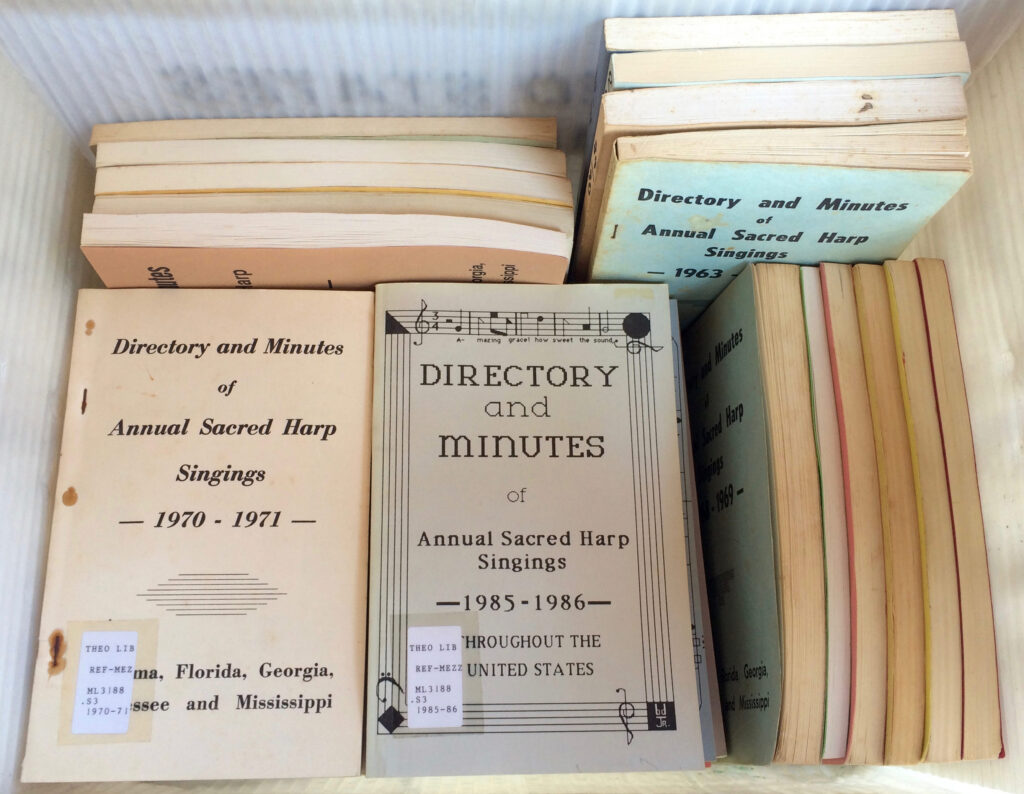
All fifty volumes included in the first and second phases of Sacred Harp Minutes Research Data and more than 100 volumes in the third phase were digitized by the Emory Libraries Digitization Program. Volumes in the collections of the University of West Georgia, the Sacred Harp Museum, and private individuals were temporarily loaned to Emory for digitization. These volumes were digitized on a Kirtas book scanner and cropped, de-skewed, and binarized by the LIMB Software.
Four additional volumes in the third phase were digitized in the Emory Center for Digital Scholarship using an Epson Expression 10000 XL flatbed scanner. These volumes were cropped, and rotated using Adobe Photoshop. Eleven additional volumes in the third phase were digitized using unknown equipment and software, including nine by private individuals prior to their donation to the project, one by the Library of Congress, and one by Brigham Young University’s Harold B. Lee Library Access Services department.
The resulting page images are being checked for completeness by a crowd-sourced team of volunteers drawn from the present day Sacred Harp singing community.
Optical Character Recognition and Manual Correction
Page images for each volume are then uploaded to the Tranksribus platform. Once uploaded, volumes are processed for layout analysis and text recognition.
Project volunteers then manually correct the optical character recognition (OCR) results seeking to achieve diplomatic transcript–quality accuracy.
Parsing and Metadata
Once manual correction of a minutes volume is complete, the minutes data is exported as plain text from Transkribus, parsed to split the text up into component events, and ingested into a database for minutes from Sacred Harp singings.
The plain text of the minutes is complemented in the database by metadata describing the minutes publication from which the data was extracted and information about the singing location, including GIS coordinates researched by members of the project team, and information about each song in the edition of The Sacred Harp used at the singing recorded, contributed by SHPC.
In addition to this data documenting singings and songs, the minutes are passed through a parser that draws on thousands of singer-contributed name corrections and updates to identify the songs sung at each singing and the song leaders responsible for leading them. This fine grained information makes possible analysis of the singers and songs sung at Sacred Harp singings.
Future Steps
We plan to release multiple versions of this research data to make information about historical Sacred Harp singings available and easy to explore and analyze for singers and scholars. In addition to publishing this data in iOS and Android verions of the Fasola Minutes app, we plan to publish a dataset as a set of CSVs, to launch a simple web app for browsing this data, and to create a queryable database with an API.
We also are working with our collaborating organizations to formalize a unified data format and metadata profile for both historical minutes being digitized for this project and born-digital minutes, enabling the ingest of minutes from future years and coordination with SHMHA’s minutes submission and editing process.
We welcome your suggestions on ways the minutes could be made available.