The digitized minutes make it possible to associate dozens of previously inaccessible private collections of home-made Sacred Harp singing recordings with time and place by documenting a sequence of songs in a given recording and algorithmically matching the sequence to minutes data.
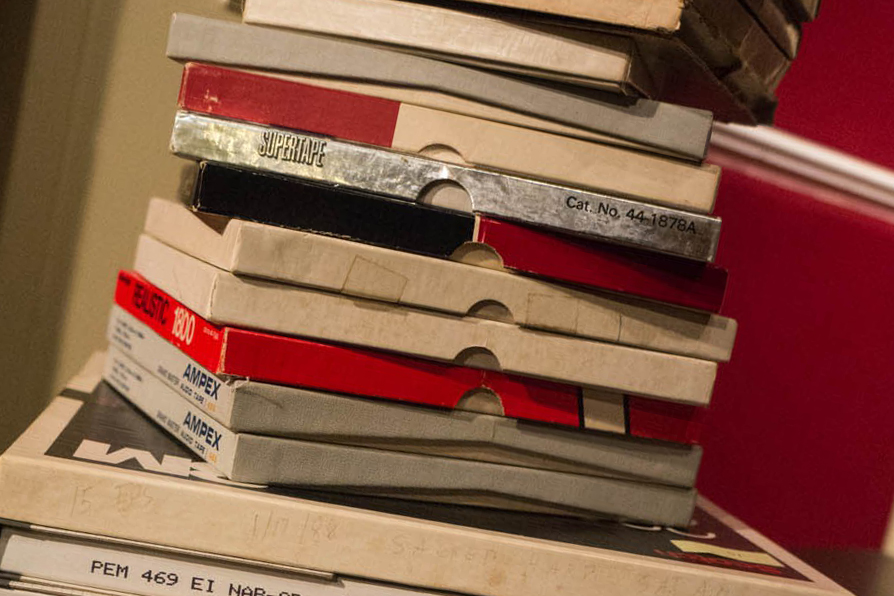
Numerous Sacred Harp singers from Georgia, Alabama, Mississippi, Florida, and Texas have collections of recordings they or their singing friends and relatives made at Sacred Harp singings since the 1950s on transcription discs, open-reel tapes, audiocassette tapes, or in born-digital formats. Additional recordings have found their way into the archives of the Sacred Harp Museum of SHPC and Pitts Theology Library at Emory University.
If you have recordings of Sacred Harp singings on physical media or in digital form and would like help digitizing them or making them available, please get in touch! The Sacred Harp Museum and Pitts Theology Library have partnered to offer digitization and archiving support. Our goal is to preserve Sacred Harp recordings and increasing the breadth of Sacred Harp recordings for available to singers and for additional research.
A common challenge with historical Sacred Harp recordings is identifying what Sacred Harp singing they document. Many are unlabeled or feature markings that are worn or difficult to interpret. Because there are so many songs in The Sacred Harp, a sequence of a modest subset of songs sung at a given singing comprises a unique fingerprint of the event. This project uses a custom-designed algorithm to match these sequences of songs identified in the recordings with information from the Sacred Harp Minutes database to determine likely matches for unidentified recordings.
Our team is also using recordings where the singing documented is known as training data to develop a computational listening program to automatically identify sequences of songs in recordings. As the accuracy of this program improves, we will increasingly be able to identify singing’s documented on recordings without having to manually documenting the content of the recordings.
Donors and Loaners of Singing Recordings from Private Collections
- P. Dan Brittain (1946–2023)
- J. H. Carter (1889–1971)
- Buell Cobb (1944–2025)
- Andy Ditzler
- Nate Green
- Rachel Wells Hall
- J. C. Harden (1906–2004)
- Bill Houston
- Bruce Johnson (1929–2022)
- Kevin Kennedy
- Oliver Kindig-Stokes (1993–2015)
- James Page
- Nathan Rees
- Mischa Skeeter
- Michael Spencer
- Robert Stoddard
- Ted Stokes
- Charlene Wallace (1929–2019)
- Bill Windom (1937–2020)
- Terry Wootten
Project Team
- Mark T. Godfrey, lead developer
- Jesse P. Karlsberg, lead researcher
- Michael Graves, sound engineer, phase 1
- Nathan Rees, sound engineer, phase 2, and outreach coordinator
- Jonathon M. Smith, outreach coordinator