We are excited to share that the first set of new minutes data digitized through the Sacred Harp Minutes Research Data project are now available! The minutes comprise hundreds of singings from 1992 through 1994.
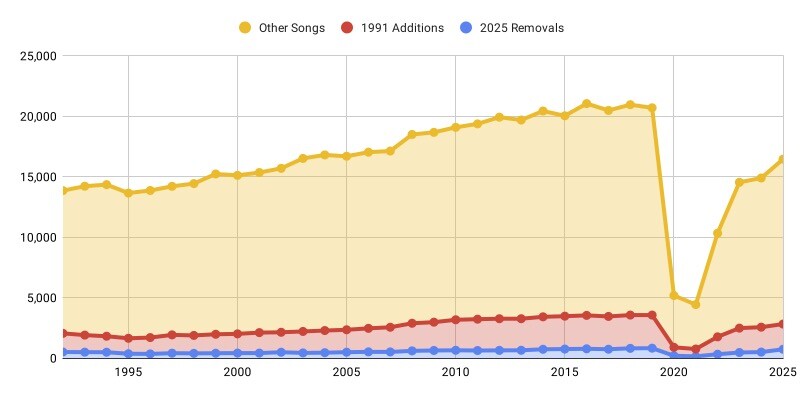
The dataset is the first to capture the full set of singings out of one of the editions of The Sacred Harp. With the introduction of The Sacred Harp: 2025 Edition, we decided to prioritize manual correction and experimental parsing of the minutes from these three years. Paired with the minutes from 1995 through 2025 that are already available, the 1992–1994 minutes would comprise a comprehensive record of Sacred Harp singings during the thirty-four year period when the 1991 Edition was the primary Sacred Harp edition in use. Together, the minutes from these thirty-four years include more than 7,500 annual singings from The Sacred Harp.
Today we added the minutes from singings for these three years through the Fasola Minutes App. We also released an updated parser on our GitHub repository that accounts for different conventions in the pre-1995 minutes and includes location information for most singings held during this three year period that were not already included in project metadata. We plan to share the data with our partner SHMHA for inclusion in the online minutes search interface at Fasola.org as well.
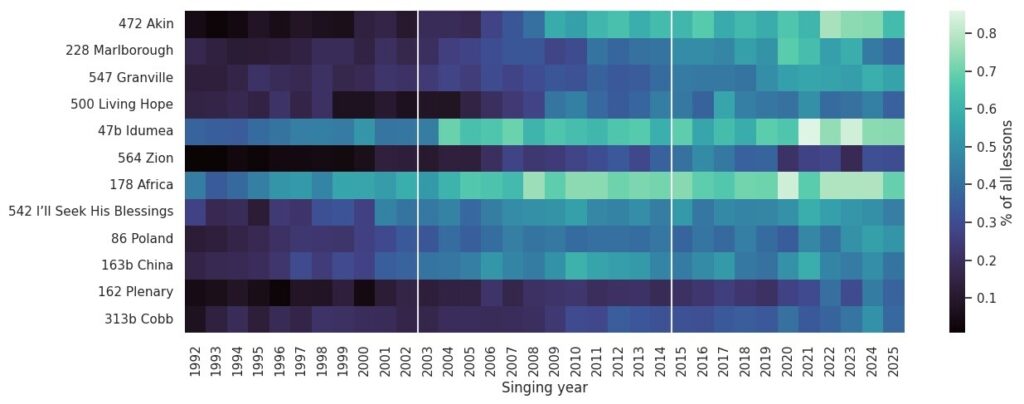
Jesse P. Karlsberg and Mark T. Godfrey presented a class at the Camp Fasola Singing School today to share a series of data visualizations drawing on this corpus that chart shifts in the geography, demographics, and repertoire of Sacred Harp singings during this thirty-four-year period. The research documented:
- The dip and recovery in participation in Sacred Harp singings during the Covid-19 pandemic,
- A dramatic expansion from the US Southeast to locations across the United States and Europe, and
- How songs added to The Sacred Harp were adopted across this geography over time.
Our thanks to go Erin Fulton and Leigh Cooper who manually corrected minutes from these three years, to the Atlanta Interdisciplinary AI Network for support of this work through a 2024 seed grant, and to the singers who offered feedback on our process and experiments and who attended the Camp Fasola presentation, providing feedback and sharing exciting new ideas about what we could learn from this documentation of our shared history.
Leave a Reply